Category Archives: Health

Hepatitis A and berries

Hepatitis A.  The Sydney Morning Herald National News Article.  The article above talks about a Hepatitis A outbreak in Australia February 2015 caused by frozen raspberries. I thought it was funny because as I was reading it, I was drinking a frozen fruit smoothie. All of the berries picked in Chili were shipped to China for washing and then distributed around in different countries. This article caught my eye not only because it was out of the country and different but the fact that I had no idea I could catch a disease from a berry. “Given the very broad spread of this product, its popularity and its very long shelf life, it’s not unexpected that we will get other cases,” (AAP, p.10), says Mark O’Connor, a compensation lawyer. At the time the article was written, about 18 people had been diagnosed. AK Wasilla
Blueberries and Lingonberries in Pie

Blueberry Cranberry (lingonberry) Pie, muffins, anything Mixing about half and half of blueberries and cranberry (lingonberry) pie adds a surprisingly tasty zing. It’s also a nice way to use lingonberries in a pie. If you make an all lingonberry pie, it can be a little overwhelming, but half and half is just about right for my taste. As I mentioned earlier in my post on blueberry and raspberries for breakfast, I prefer not to add sugar to my berries which is part of the reason that I have a hard time using lingonberries. Now that I know lingonberries top the charts in antioxidants, I want to try to incorporate them even more into mine and my family’s diet. Of course, extrapolate from pie, and half blueberries and half lingonberries will do in just about any baked good or jam you are making.

Holloway, P.S., R. Dinstel and R. Leiner. 2006. Antioxidants in Alaska Wild berries. Georgeson Botanical Notes No. 35. Available Online: Berries and Antioxidants

Anthocyanin Composition and Antioxidant Activity of the Crowberry

Thirteen kinds of anthocyanins were identified in freeze dried crowberry extract. The total content was higher than nine other major berry species. It also held the highest antioxidant content.

Crowberries are suggested to help prevent chronic diseases due to their high antioxidant activity. KH Fairbanks
Kenjirou, Ogawa. Hiroyuki, Sakakibara.Rei, Iwata.Takeshi, Ishii. Tsutomu, Sato. Toshinao, Goda. Kayoko, Shimoi. And Shigenori, Kumazawa. 2008. “Anthocyanin Composition and Antioxidant Activity of the Crowberry.” Journal of Agric.Food Chem. 56 (12) pp4457-4462.

Uses of Berries

As we are learning more about wild & cultivated berries of Alaska, I was wondering what others uses berries might have. I found a page made by Tanana Chief’s Conference and wanted to include the information they have on their website!

Spruce Tree needles –

Symptoms: Burns, Childbirth, colds/ flu, sinus infections, sore throat, stomach troubles, tuberculosis, urinary problems, stomach issues, cuts or scrapes, skin troubles, childbirth.

How to use: Boil needles to release scent in air, you can also bathe in the needles, chew the needles, steam, or salve.

Burns: Heat spruce pitch and apply to relieve

Colds/Flu: Spruce bark tea/Spruce needle tea

Childbirth: Mixture of Spruce gum/ charcoal applied to child’s navel Most common uses: Spruce Bark & Spruce Pitch will be either boiled or chewed for applications

Rose Hips –

Symptoms: Rose hips are high in Vitamin C, A, B, E, & K. Good for immune system, heart/circulatory systems, nervous system, anti-inflammatory

How to use:

Skin: Rose hip oil can help with moisturization, and can be used to treat scars and acne

Burns: Rose Hip oil can be used as a soothing treatment on skin burns Organ Systems: Can help with the immune, digestive, reproductive, and heart/circulatory/nervous systems.

Most common uses: Rose hips are used in a tea, eaten raw, cooked, made into jelly.

TCC’s Guide to Natural Medicine. Uses of Berries Accessed 21 Sept, 2016.

Antioxidants

Antioxidants in Blueberries

Alaskan blue berries are found to be extra special comparative to blueberries cultivated in the lower 48. Alaskan blue berries were found to have “3 to 5 times higher” higher levels of antioxidants then their southern cousin. Antioxidants have gone through the nutritional “hype” on weather or not you want a lot of them in your body or not, but if you need them, stepping right out your back door is the best place to look!  LF Fairbanks


Dinstel RR1, Cascio J, Koukel S. 2013. The antioxidant level of Alaska’s wild berries: high, higher and highest. Available online: http://www.ncbi.nlm.nih.gov/pubmed/23977647 Accessed 14 Sept, 2016.

Endophytic microbiome in crowberry? What?

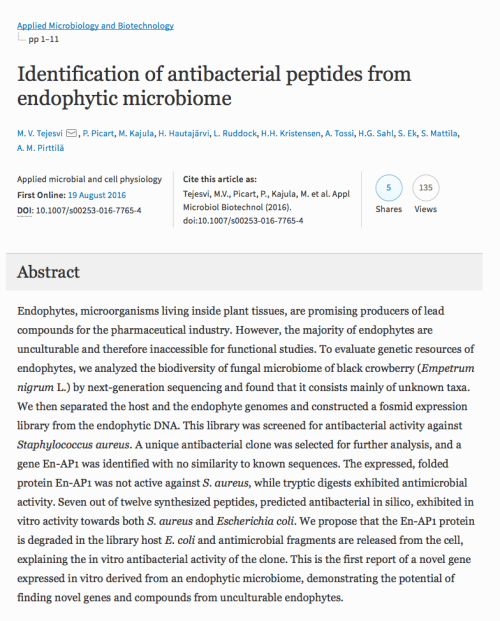
I have to admit. I had to look up what endophytic micro biome was, but it is truly fascinating. They are microbes that live inside plant tissues, in this case, the crowberry, Empetrum nigrum. The authors identified one of these microbes inside the crowberry that has antibacterial activity, specifically a Staphylococcus bacterium. They propose that the presence of this endophyte might have value in the pharmaceutical industry to fight bacterial diseases. So the crowberry itself is not antibacterial. It’s a litter microbe inside the tissues! empetrum

Haskap oral delivery system

I first read this thesis and laughed hysterically at the thought of developing an “oral delivery system for haskaps”. The author experimented with methods of optimum release and absorption of anthocyanins from haskaps. She developed “a theoretical physiologically-based, multi-compartmental pharmacokinetic (PBPK) model to describe the fate of anthocyanin”. Got that? So my myopic brain thought, “Here’s a novel oral delivery system– just eat the berries!”  Right?  After I stopped laughing, I read a little deeper and learned this article very seriously addresses haskaps as medicine. Think about a Type 1 diabetic who needs shots or a pump to deliver a measured amount of medicine throughout a 24-hour period. This research attempts to find out the best way to deliver measured amounts of anthocyanins from haskaps over long periods. I still prefer shoveling the berries into my mouth, but what would happen if you constantly bathed your cells in anthocyanins over hours, days, years? Interesting thought!

Haskap medicine

Aronia Cultivation and Research

This article summarizes current research at Iowa State on Aronia cultivation.  It includes short summaries on field cultivation all the way to health benefits.

Aronia Berries

And these researchers in Wisconsin are honing in on the antioxidant components of Aronia and whether they can be absorbed by animal systems. Lots of berries have many chemicals labeled as antioxidants, but many of them never make it out of the intestines or into the brain, so their value may not be what is claimed.

Aronia berries and antioxidants

Blueberries and health

This summary of ongoing research shows some of the health benefits of blueberries from brain health to slowing down the process of graying hair. Interesting tidbits throughout, although they are mostly talking about “lower 48” species of blueberries. (Ours are probably better! Ha!)

Blueberry research for your health


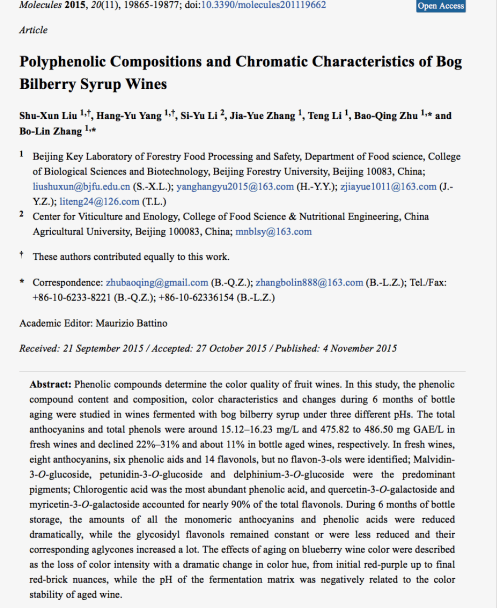
Color and antioxidants in bot blueberry wine

This is an interesting article from China that examines the changes in antioxidants of bog blueberry in winemaking as the wines age.

V. ulig wind

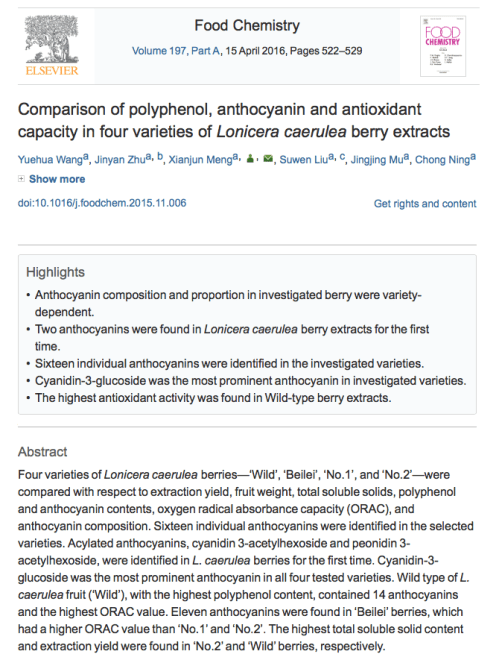
This research examines the polyphenol, anthocyanin and antioxidant capacity of 4 cultivars of honey berry extracts. The abstract and citation are included.

AbstHaskap antioxidantsract

Processing and phenolic compounds in honey berry

The aim of the study was to evaluate different methods used for the preparation of powders from blue honeysuckle (Lonicera caerulea L. var. kamtschatica) cv. ‘Wojtek’, and the effects of these methods on chemical composition and antioxidant activity of lyophilized powders and pomace. The analyzed samples were evaluated for their basic chemical composition (dry weight, pH, total acidity, sugars (glucose, fructose and sucrose), and antioxidant capacity (FRAP, ABTS). Polyphenolic compounds were identified and quantified by UPLC-PDA-MS/MS. Thirty eight polyphenolic compounds, including eight phenolic acids, eight anthocyanins, five flavan-3-ols, twelve flavonols and five flavones were identified in blue honeysuckle products. The highest content of bioactive compounds was detected in juice pressed from peels, as compared with fresh berries and other products. Moreover, crushed berries were found to be a better material for obtaining dried product than intact fruit. Jan OszmiańskiAneta Wojdyło, and Sabina Lachowicz. 2015. LWT- Food Science and Technology. 2015. Effect of dried powder preparation process on polyphenolic content and antioxidant activity of blue honeysuckle fruits (Lonicera caerulea L. var. kamtschatica) Available Online: Abstract

Highbush Cranberry Bark as medicine

Highbush cranberry bark Highbush cranberry has traditional uses beyond foods created from its berries.  The bark is also used for medicinal purposes.  The Alaska Native Knowledge Network has an entry from Eleanor Viereck’s book here http://www.ankn.uaf.edu/curriculum/Books/Viereck/viereckhighbush.html. Audrey Sunnyboy’s book Denyaavee, recommends using one teaspoon of dried bark or one tablespoon of fresh bark per one cup of boiling water to make a tea.   To harvest the bark, simply use a vegetable pealer and shave off some bark.   Viereck, E. 1987. Alaska’s wilderness medicines: Healthful plants of the far north. Alaska Northwest Books. Anchorage, AK. Sunnyboy, A. 2007. Denyaavee. Medicine plants of interior Alaska’s People.

Bioactivity and Health Considerations

A very well done paper on the bioactivity and health considerations of many o the berries we have studied during this course. (Vaccinium ovalifolium, Vaccinium uliginosum, Rubus spectabilis, Rubus chamaemorus, Empetrum nigrum)  I like that they chose 3 different locations in Alaska, but I think they could have done without climate change in the title, for it was almost not even addressed.  A good read nonetheless.  Antioxidants

Honeyberry Antioxidants

Are Honeyberries the Newest Superfood?

If you’ve ever used honeyberries (aka haskap aka blue honeysuckle) in a recipe, you know how deep blue they are.  A handful of honeyberries can turn a whole recipe purple.  That much color has got to mean lots of antioxidants, right?  Research seems to suggest that they are indeed a nutritional powerhouse.  Here’s a link to a summery of several studies:   Honeyberry Antioxidants

Carotenoids in Berries

The ripened color of the cloudberry made me curious as the carotenoid content of the berry.  I found this research paper that compared carotenoid levels of 4 northern berries.  The cloudberry (Rubus chamaemorus), blueberry (Vaccinium myrtillus), cranberry (Oxycoccus palustris) and cowberry (Vaccinium vitis-idaea) were compared in this study.   Carotene

Bearberry Medicine

Berries have so many great health attributes (nutrients, antioxidants, vitamin C, even iron in some cases), it is not only the fruiting part of a plant that humans have used medicinally.  Before the advent of sulfa drugs, bearberry (Arctostaphylos uva-ursi) was used to treat urinary tract infections and chronic cystitis.  It is still used in alternative medicine, and with the increase in antibiotic-resistant UTI bacteria, it is being looked at again.  You can take a commercial extract (pill), or make a tea from the dried leaves.  Uva ursi contains tannins (which shrink mucus membranes) and antibacterial compounds like hydroquinone and arbutin.  It is most effective when taken at the beginning on an infection, and should only be taken for up to 5 days at a time.

Caution–bearberry should not be taken as a preventative.  One of the components, hydroquinone, can cause serious liver damage. Do your research, check your dosages, and talk to a medical professional before you decide to try uva ursi for urinary problems.  Bearberry medicine

More about bearberries

Raisins, Juniper berries and rheumatoid arthritis?

Gin-soaked raisins for rheumatoid arthritis?

My mother has RA, and her doctor told her that one folklore remedy is to soak raisins in gin, and eat 9 raisins every day.  While I’m all for enjoying the occasional drink with or without dried fruit, this seemed a bit funny to me, and I have done a little bit of surfing for more info.  Juniper berries used to flavor quality gin ARE known for their anti-inflammatory properties.  Raisins (yellow raisins specifically) are treated with sulfur dioxide to keep their color, and sulfur may have anti-inflammatory effects.  Plus raisins, like many fruits, have anti-oxidant properties.

Pro:  The People’s Pharmacy People’s Pharmacy

Con:  Snopes.com Snopes Review

In the Middle:Alternative Daily

Verdict?  If you like raisins, and you like gin, it probably won’t hurt you and maaaaybe it will help.  Don’t like raisins or gin, or don’t drink alcohol?  Skip it!

Haskap antioxidants

A great paper published in June of this year on the anti-inflammatory potential of Lonicera caerulea (haskap).  It specifically mentions the Borealis cultivar, as having the highest polyphenolis content. I will definitely be attempting to grow some on my property in the near future! Haskap antioxidants

Berry Antioxidants and Cancer

An interesting article from Scientific American–taking antioxidant supplements may make certain types of cancer grow faster.  Some very specific types of cancer cells are susceptible to attack by free radicals (melanoma is the biggest example).  Some studies have shown that antioxidant supplements can protect these cancer cells, in addition to the rest of the cells in the body.   Antioxidants and Cancer The take-away message should NOT be “Antioxidants cause cancer.”  The take-away message, I think, should be that if you are taking supplements and are diagnosed with certain types of cancers, stop taking supplements.  Continue to eat a normal healthy diet that contains whole foods with naturally-occurring antioxidants, but do not load up on extras.