
Category Archives: Berry Types

Spruce Bark Beetles and Berries

Being from the Kenai Peninsula and having first hand experience with spruce bark beetle die off in my home town of Moose Pass, it was interesting to read the effects the spruce bark beetle die off had on berry populations in the area. This article goes into depth about the effect tree coverage had on the berry stands in the area after the trees began to grow back after the spruce bark beetle die off. Each berry tested had slightly different results, but for the most part they averaged being the most productive at 50% coverage, then loosing productivity after that. BE Moose Pass, AK

Abstract: “Land managers on the Kenai Peninsula have responded to recent extensive infestations of forests by spruce beetles (Dendroctonus rufipennis (Kirby)) and associated increased fire risk with a variety of management approaches. To provide additional ecological information upon which to base these management prescriptions, we evaluated the response of the cover of berry species to variations in landscape factors and environmental conditions, including crown closure. Data were sufficient to describe the response of cover of bunchberry dogwood (Cornus canadensis), black crowberry (Empetrum nigrum), false toadflax (Geocaulon lividum), strawberryleaf raspberry (Rubus pedatus), lingonberry (Vaccinium vitis-idaea), and a combination of 24 other species through multinomial logistic regression. Crown closure and forest overstory type significantly influenced the cover of all berry species. Increasing crown closure had a negative effect on all berry species except strawberryleaf raspberry. Level of infestation by spruce beetles was significantly related to the cover of all species except lingonberry. Our findings indicate that spruce forests may be managed to enhance berry cover and that choice of management technique (e.g., timber harvest, prescribed fire) will likely result in different outcomes.”

During, L.H., M.I. Goldstein, S.M. Howell and C.S. Nations. 2008. Response of the cover of berry-producing species to ecological factors on the Kenai Peninsula, Alaska, USA Canadian Journal of Forest Research.Vol. 38, No. 5 : pp. 1244-1259
Blueberries and Lingonberries in Pie

Blueberry Cranberry (lingonberry) Pie, muffins, anything Mixing about half and half of blueberries and cranberry (lingonberry) pie adds a surprisingly tasty zing. It’s also a nice way to use lingonberries in a pie. If you make an all lingonberry pie, it can be a little overwhelming, but half and half is just about right for my taste. As I mentioned earlier in my post on blueberry and raspberries for breakfast, I prefer not to add sugar to my berries which is part of the reason that I have a hard time using lingonberries. Now that I know lingonberries top the charts in antioxidants, I want to try to incorporate them even more into mine and my family’s diet. Of course, extrapolate from pie, and half blueberries and half lingonberries will do in just about any baked good or jam you are making.

Holloway, P.S., R. Dinstel and R. Leiner. 2006. Antioxidants in Alaska Wild berries. Georgeson Botanical Notes No. 35. Available Online: Berries and Antioxidants

The Search for Lingonberries

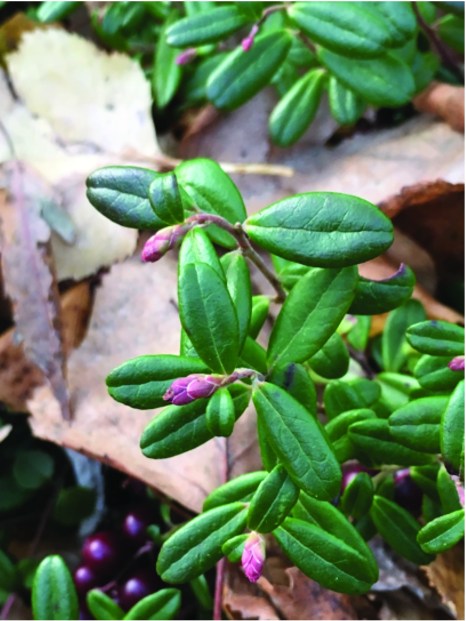
lingon-flower-buds
After a solid afternoon of studying, my younger sister and I headed out for a walk around the neighborhood. Because we live next to a powerline cut, I thought that was a good place to go look at various plants and vegetation. We came across multiple stands of lingonberries. I didn’t know that we had so many close to our house. My sister enjoyed eating them after I explained what they were. She is a berry eating machine! I personally don’t care for raw lingonberries, but she was all over them. There are plenty more to go out and pick. We had fun counting all the buds that will hopefully turn into berries for next year. It made for a fun afternoon. CM Fairbanks

Anthocyanin Composition and Antioxidant Activity of the Crowberry

Thirteen kinds of anthocyanins were identified in freeze dried crowberry extract. The total content was higher than nine other major berry species. It also held the highest antioxidant content.

Crowberries are suggested to help prevent chronic diseases due to their high antioxidant activity. KH Fairbanks
Kenjirou, Ogawa. Hiroyuki, Sakakibara.Rei, Iwata.Takeshi, Ishii. Tsutomu, Sato. Toshinao, Goda. Kayoko, Shimoi. And Shigenori, Kumazawa. 2008. “Anthocyanin Composition and Antioxidant Activity of the Crowberry.” Journal of Agric.Food Chem. 56 (12) pp4457-4462.

Crowberry Pie

Recipe for Crowberry Pie:

-Pastry for double-crust, 9 inch pie (unbaked)

-4 C crowberries

-2 Tbsp lemon juice

-1 C granulated sugar

-1/3 C flour

-1/8 tsp ground cloves

Line pan with pie crust. In a large mixing bowl combine crowberries, lemon juice, sugar, flour, and cloves; mix well and pour into unbaked pie shell.

Dampen edge of shell with water, add top crust and flute edge. Slit top of pie.

Bake at 425F for 10 minutes.

Reduce heat to 375F and bake for 30 minutes.

Remove and cool.

Yields 6-8 servings

Source

Blueberry Wine

This is an article about the uses of mainly Blueberries and their uses in the process of winemaking. The author, tells the story of John Tamburello, and how he got his start in winemaking as well as some of the berry conditions that influence the taste of the wine such as rainfall, size and insect populations. At the end he even goes over the various flavorings of the wines. Overall a very informative and inspiring read for those who wish to learn about winemaking.

Chiasson, B. 2016. Blue wine and berries. Available online: winemaking Accessed 21 Sep, 2016.

Uses of Berries

As we are learning more about wild & cultivated berries of Alaska, I was wondering what others uses berries might have. I found a page made by Tanana Chief’s Conference and wanted to include the information they have on their website!

Spruce Tree needles –

Symptoms: Burns, Childbirth, colds/ flu, sinus infections, sore throat, stomach troubles, tuberculosis, urinary problems, stomach issues, cuts or scrapes, skin troubles, childbirth.

How to use: Boil needles to release scent in air, you can also bathe in the needles, chew the needles, steam, or salve.

Burns: Heat spruce pitch and apply to relieve

Colds/Flu: Spruce bark tea/Spruce needle tea

Childbirth: Mixture of Spruce gum/ charcoal applied to child’s navel Most common uses: Spruce Bark & Spruce Pitch will be either boiled or chewed for applications

Rose Hips –

Symptoms: Rose hips are high in Vitamin C, A, B, E, & K. Good for immune system, heart/circulatory systems, nervous system, anti-inflammatory

How to use:

Skin: Rose hip oil can help with moisturization, and can be used to treat scars and acne

Burns: Rose Hip oil can be used as a soothing treatment on skin burns Organ Systems: Can help with the immune, digestive, reproductive, and heart/circulatory/nervous systems.

Most common uses: Rose hips are used in a tea, eaten raw, cooked, made into jelly.

TCC’s Guide to Natural Medicine. Uses of Berries Accessed 21 Sept, 2016.

A Forestry Experiment

Cranberries lost and found. When I was younger the area where I grew up used to be full of spots to pick lowbush cranberries (lingonberries). My family and I did not even have to go far. We could just ride our bikes down some local back roads and the berries would be growing all around; next to the roads and along the edges of the woods. There were some very nice spots deeper into the woods where the poplar and quaking aspen trees grew. The woods were not dense and the forest floor had many sunny and shady spots; the berries grew in abundance. But all this abruptly changed about four years ago on the evening of Sept. 15th 2012, an immense wind storm began to blow. The storm lasted for a few days after but the night of the 15th was of a certainty the worse any of us had ever seen. The winds were so strong that some of the blasts were rated as being hurricane force though no rain accompanied them. When it was all said and done nearly 500 acres of trees in the surrounding forests and valleys had been blown over. Because of the shallowness of their root systems when trees fell their wide root systems pulled great hunks of the forest floor with them. Many of our usually berry patches were literally ripped up by their roots and still many more were buried by fallen trees and branches. Our trails became essentially impassible, and the aspect of the forest changed so much that once familiar landscapes had become a shocking picture of nature’s destructive force.
This event attracted the notice of the local forestry division and they began to look more closely at our area. One forester in particular had a burden to make our area a safer residential zone; he felt that the thickness of the forests near our roads and near our houses was an extreme fire danger. In the summer of 2014 forestry sent a large crew to our area and they began to clear the trees near all the roads. We thought that this would be a relatively small project. A continuation of the cleanup projects that they had been helping us and the others in the area with because of the Great Storm. Time past and the tree lines along the roads moved back from 10ft to 20ft and more; then forestry decided more clearings deeper into the forests needed to be created as LZs for supplies and crews if a fire did occur. They did much cutting with chainsaws which was not very damaging, but this took too long so they brought a great drum with metal ribs on its outsides and filled with water. This giant cylinder was pulled behind a big piece of equipment and reduced acres of forest to great openings filled with ripped up vegetation and crushed timbers. Needless to say any and all berries in these areas have been completely eradicated. I and others in the valley have found other patches deeper into the forests and so all is not lost, but I do wish that in their quest to make us all safer forestry had not been so completely successful in removing all burnable substances for miles around. This project is still ongoing even this summer a crew was working behind our homes deeper into the forest cutting more and burning great piles of brush.
I understand the need for safety but I do hope that one day the berry patches will come back. A few of the men in our neighborhood, who own and run a logging and milling business, say that given time the torn landscapes most likely will grow up into deciduous forests. They hope that the increased sunlight and nutrients will begin to bring long dormant seeds to life. I see this being a good thing as in the past the best patches I found were under the canopies of deciduous trees. I have put in a few interesting links about lingonberries and the likely hood of whether the old patches I used to know will ever return. I have looked for info on the particular method of tree removal that I mentioned, but apparently it was an experiment forestry was trying. Their hope was that the deciduous trees would come back and are keeping an eye in this area to see how fast the forest takes to regrow including the underlying groundcover such as berry bushes. Because it is a new method I could not find much info about it I guess only time will tell. I will continue to watch the patches of cleared land to see how fast.the vegetation takes to come back. The following links are simply interesting research articles on Lingonberries and Alaskan berries that are important to Alaskan communities in general. AB Delta Junction
Websites:
By Richard G. St Pierre, Ph.D. 2016
Accessed Sept. 19,
By Various researchers: Michael Brubaker, Jerry Hupp, Kira Wilkinson, Jennifer Williamson.
Accessed Sept. 20, 2016

A lesson learned – Blueberry Pancakes +

A Lesson Learned
As the great Alaskan holiday known as hunting season continues, the stories of the ones that got away and the exciting trips we’ve taken often get told at my dining room table over dinner. One of my favorite stories occurred on my first ever hunting trip when I was eight years old.
There was a large group of family and friends all together camping out on the banks of the Salchaket Slough just outside of Fairbanks. In the early mornings everyone would get up and head out to find the moose. By midmorning most of us would be back at camp, ready to make breakfast. On this particular morning we were having blueberry pancakes, made with freshly picked blueberries that bored me had foraged for instead of looking for moose. The camp stove was heated up and the pancake mix measured and stirred. The blueberries came next. My third grade self was ecstatic that the batter turned purple, a rookie mistake. I kept stirring with renewed vigor and in my excitement I dropped the spoon on the ground. A family friend retrieved it, the batter covered in dirt. I was upset, now we would have to find another spoon or rinse that one off. My friend winked at me and put the spoon back into the bowl, mixing it once again, dirt and all. That’s when I learned one of the most important lessons of my life, “A little dirt won’t hurt.” Those are still the best pancakes I think I’ve ever had.
Blueberries still hold a special place in my heart. Every year that I’ve gone out hunting I’m always sure to pick the last berries still holding on as an ode to those pancakes several years ago. Harvesting moose this year? Nope, I’m harvesting berries. CM Fairbanks

Straw bale gardening and strawberries

Who needs Dirt?
I really want to grow a nice, easy to care for, patch of productive strawberries in my garden. This has been one of my goals ever since I began caring for said garden, but I just never could seem to find the time or come up with a good plan that would be easy to implement and easy to care for. In the past few years I have begun to make connections and friendships with the people at the local co/op in the Delta Jct. area. I have found in them to be a wonderful group of people; who are willing and eager to answer all questions about my garden and have helped me to learn and try new methods for working both in my vegetables and my berry crops. Some of these kind people have even come out to where I live to look at my garden and give me hands on advice about fertilizers, watering methods, soil content, and weed prevention along with a myriad of other hints and tips.
Along with the professionals who work full time, the co/op also recently hired a local lady from Delta who is a long time Alaska gardening and has a great deal of practical knowledge and experience with gardening in Alaska. She and I have become friends and she has come out a few times to visit my garden as well. Just this last July she came out and we began talking about growing this and that. She brought up the topic of Straw Bale Gardening and asked if I had ever heard of it. I had not so she gave me a quick synopsis of how it was done; she then mentioned that strawberries could be grown in this way as well and that really piqued my interest. I have since done some research of my own and am intrigued by the whole idea. The info that I have found says that strawberries are an ideal candidate for growing in straw-bales and hay-bales, at least the annual varieties of berries are. Because of the plants compact size and small root systems many can be planted in one bale and are protected very well from pests and weed infestation. The straw bales are relatively easy to set up, don’t take up much room, and after the year is done the old worn out bales can be composted further and tilled back into the garden or simply used as mulch. Simple and not wasteful; I am eager to try out this method of berry growing next summer to see if it will work for me. I was wondering if anyone had any advice as to the best variety of annual strawberries to grow in Alaska and if they knew of any good suppliers of transplants that I could order from. Here are a few links to sites that have good information both on berry growing in bales and veggie growing in bales. I also found a few good Youtubes that show how to implement the methods, just look up (straw-bale gardening youtubes) and watch some of them.  AB Delta Junction
Website:
By Brian Barth. How to grow strawberries in Hay Bales. Available online: http://motherhood.modernmom.com/grow-strawberries-hay-bales-13105.html 2016
. Accessed Sept. 18,
By Ellen Douglas. How to grow strawberries in Hay Bales. Available online: http://homeguides.sfgate.com/grow-strawberries-hay-bales-30457.html. Accessed Sept. 18, 2016
By No Dig Vegetable Gardening. Straw Bale Gardening. Available online: http://www.no-dig-vegetablegarden.com/straw-bale-gardening.html. Accessed Sept. 18, 2016
Youtube:
Straw Bale Gardening. Available Online: Sept. 18, 2016
https://www.youtube.com/watch?v=uXtylj7P7OE,

Blueberries and Pasta

I have never actually tried a berry recipe, I have always just made jelly, pies, or pancakes out of the berries that I harvested so finding a pasta recipe with blueberries was really interesting and I thought I would share it with you.

Eatingwell.com Chicken and Blueberry Pasta Salad

Original recipe yields 4 servings
The Ingredients-
1 pound boneless, skinless chicken breast, trimmed of fat
  • 8 ounces whole-wheat fusilli or radiatore
  • 3 tablespoons extra-virgin olive oil
  • 1 large shallot, thinly sliced
  • 1/3 cup reduced-sodium chicken broth
  • 1/3 cup crumbled feta cheese
  • 3 tablespoons lime juice
  • 1 cup fresh blueberries
  • 1 tablespoon chopped fresh thyme
  • 1 teaspoon freshly grated lime zest
  • 1/4 teaspoon salt

Preparation

  1. Place chicken in a skillet or saucepan and add enough water to cover; bring to a boil. Cover, reduce heat to low and simmer gently until cooked through and no longer pink in the middle, 10 to 12 minutes. Transfer the chicken to a cutting board to cool. Shred into bite-size strips.
  2. Bring a large pot of water to a boil. Cook pasta until just tender, about 9 minutes or according to package directions. Drain. Place in a large bowl.
  3. Meanwhile, place oil and shallot in a small skillet and cook over medium-low heat, stirring occasionally, until softened and just beginning to brown, 2 to 5 minutes. Add broth, feta and lime juice and cook, stirring occasionally, until the feta begins to melt, 1 to 2 minutes.
  4. Add the chicken to the bowl with the pasta. Add the dressing, blueberries, thyme, lime zest and salt and toss until combined.
  • Make Ahead Tip: Add everything except the blueberries and dressing to the pasta salad. Cover and refrigerate pasta salad, blueberries and dressing separately for up to 1 day. Toss together just before serving.
Nutrition information
  • Serving size: about 1 1/2 cups
  • Per serving: 320 calories; 11 g fat(3 g sat); 5 g fiber; 34 g carbohydrates; 23 g protein; 29 mcg folate; 49 mg cholesterol; 5 g sugars; 0 g added sugars; 82 IU vitamin A; 6 mg vitamin C; 68 mg calcium; 2 mg iron; 244 mg sodium; 254 mg potassium
  • Nutrition Bonus: Magnesium (18% daily value)
  • Carbohydrate Servings: 2
  • Exchanges: 2 starch, 2 lean meat, 1 fat

Looking at the site more in depth, I found that it has alot of healthy choices as well as treats. I look forward to trying some of these recipies out in the near future.


http://www.eatingwell.com/recipe/251887/chicken-blueberry-pasta-salad/

High bush cranberry – ketchup

High bush Cranberry…..Ketchup?

I attended an extremely small K-8 grade school in Moose Pass, Alaska. When I was in probably 3rd or 4th grade our school went out high bush cranberry picking, most of the kids did not appreciate the berries because of their tartness, but that is when our teacher came up with this brilliant idea. All of the kids loved the smiley face “French Fries”, but we would always go through copious amounts of ketchup when we had them. So our teacher found a recipe to make ketchup out of high bush cranberries. The process for making the ketchup can be tedious, but it is very rewarding and you end up canning it, so it lasts! A very important factor for Alaskan lifestyle of living. Follow the site bellow to learn how to make this delicious twist on your favorite condiment. BE. Moose Pass
Beachcomber, A. 2012. Highbush Cranberry Ketchup. Available online:http://www.alaskafloatsmyboat.com/beachcombing/2012/12/14/highbush-cranberry-ketchup accessed 14 Sept. 2016.

Strawberries

http://www.newsminer.com/features/sundays/gardening/untangling-the-confusion-of-growing-strawberries-in-fairbanks/article_e659c6ac-1d25-11e5-9ab6-ff4c5f76e46e.html

Thought it was interesting how this article broke down some of the types of Alaskan strawberries and how they grow here. Rader, H. 2015. Untangling the confusion of growing strawberries in Fairbanks. Available online:http://www.newsminer.com/features/sundays/gardening/untangling-the-confusion-of-growing-strawberries-in-fairbanks/article_e659c6ac-1d25-11e5-9ab6-ff4c5f76e46e.html Accessed on 14 Sep 2016.


Sensitivity to day length/night length
I got a question about which plants are day-sensitive and if there was a list. Wouldn’t that be a nice list to have? But boy would that be a nice list to have? It would be a long and complicated list that would need to be updated as new cultivars were developed. It doesn’t help that the terminology is not intuitive or indicative of the actual day/night length needs of the plants. It makes sense if you live in the lower 48. But in Fairbanks, Alaska, there is nothing about “June bearer” that indicates a need for short days. I wrote this article awhile back to help people better understand the importance of day length on strawberries.
Rader, H. 2015. Untangling the confusion of growing strawberries in Fairbanks. Available online: http://www.newsminer.com/features/sundays/gardening/untangling-the-confusion-of-growing-strawberries-in-fairbanks/article_e659c6ac-1d25-11e5-9ab6-ff4c5f76e46e.html. Accessed 14 Sept, 2016.

Beach strawberries

I found this video and found it particularly interesting. You cannot see the strawberries on the ground or the plants themselves because of the large amount of ground cover but yet there is still a crop of berries growing there. Makes me wonder what kind of environmental conditions that strawberries need in particular to flower and produce berries. Digstravel33. 2012. Strawberry Picking In Gustavus Alaska, Avaliable online:https://www.youtube.com/watch?v=cODDKWosfoQ Accessed 14 Sep. 2016.

Cranberry bread

f you couldn’t tell by now, I love baking as an outlet for my PTSD, so I will likely be sharing a lot of recipes that I enjoy using. One of my coworkers loves, and I mean, LOVES cranberry bread. In my search for good bread recipes, I found this little gem! I have made this several times for her, adding about 1tsp of vanilla extract, and about ¾ cup of chopped walnuts. She seems to love it, and my family does as well!

Spray, Ocean. n.d. Classic cranberry nut bread. Available online: http://www.oceanspray.com/Recipes/Corporate/Breads-Muffins/Classic-Cranberry-Nut-Bread.aspx. Accessed September 14, 2016.

Swedish lingonberries with meatballs

Being Swedish, meatballs and jam are almost as important as pickled herring in my family. I found this good recipe for Swedish Meatballs and Lingonberry sauce that is very similar to the one my grandmother brought with her from Stockholm when she moved to the United States. Granted, this recipe uses pre-made lingonberry jam, I would imagine that it would be even better with fresh-made jam! Here’s the link to the recipe, with instructions! Enjoy!  CA Arizona

Florence, Tyler. n.d. Swedish meatballs with lingonberry sauce. Available online: http://www.foodnetwork.com/recipes/tyler-florence/swedish-meatballs-with-lingonberry-sauce-recipe.html. Accessed September 14, 2016.

Inoculating blueberries with mycorrhizal fungi

Journal Article: Inoculation with Ericoid Mycorrhizal Fungi Alters Fertilizer Use of Highbush Blueberry Cultivars.
Citation: Scagel, Carolyn, F. 2005. Inoculation with Ericoid Mycorrhizal Fungi Alters Fertilizer Use of Highbush Blueberry Cultivars. HortScience 40(3):786-794.
Accessed: 13 September 2016
Comments: An interesting article about mycorrhizal fungi and several blueberry cultivars container grown, in a nursery. It appears more work needs to be done to better understand the relationships between the fungi and blueberry cultivars.

Raspberry Jam

Berry Jam

During my time in Alaska I had a very healthy raspberry patch. As they are my all time favorite berry I canned quite a bit of jam to serve on everything…waffles in the morning, biscuits at night, and ice cream for dessert! I like to keep foods as healthy and simple as possible for my kids. The following link has a great step by step for making the same type of jam that I make for my family. CS

http://www.theyummylife.com/Berry_Jam

Lemons and blueberries!

Recipe: Lemon Blueberry Cake with Cream Cheese Frosting by Cooking Classy.
Citation:
Jaclyn. 2014. Lemon Blueberry Cake. Available online: http://www.cookingclassy.com/2014/05/lemon-blueberry-cake/.
Accessed 2 September, 2016.
Comments: I made this cake last week with fresh blueberries and it was delicious. Many friends who tried it, have asked for this recipe.  CZ Anchorage

To use berry pickers or not

Berry Picker: Good or Bad?

One of the three ways to enjoy berries, as mentioned in screen cast 1, is wild berry picking. I am born and raised in Alaska and berry picking is apart of my culture, living off the land is how I grew up. One thing that came up in the screen cast was a berry picker, a device used for easier berry picking. Something that has come up a lot recently is the topic of why they should not be used. Elders in the Alaska Native community are saying that it takes away from the plant and pulls off the leaves, making for an unsuccessful berry season the next year. I wanted to bring this topic up and see what others thought and ask the experts! I would be very interested in finding out more about this, seeing as how blueberries are actually a large part of my life!  LF Fairbanks