Author Archives: Hortalaska Berries

The Baneberry

The Red Baneberry (Actaea rubra)

My property contains a diverse collection of wild berries that I am starting to become familiar with so that in the future landscaping of my yard I can incorporate these wild stands to the best of my ability. There are high and low bush cranberries, raspberries, currants, red baneberries and at least one more berry that I think is possibly dwarf dogwood berries. The berries I am most concerned about are the red baneberries and that is because I know they are toxic and I know my son is extremely curious about everything (he already ate a baneberry on his second birthday which I spent about 30 minutes over-reacting on the phone with poison control).

The Actaea rubra commonly called red or white baneberry grows on a bushy plant with large divided leaves that have jagged edges and it grows around 1-2 tall and wide. Small round clusters of white flowers grow near leaf axils and at the ends of stems. The stamens of the flower give it a fluffy almost feathery appearance and they are quite pretty. The berries grow at the ends of tall thick stems in spherical bundles of beautiful red or white berries. They are very pretty and could be used ornamentally if I was not concerned with future ingestion.

The baneberry can be propagated by root or sown by seed, which may take 2 years to germinate and can begin to flower in the third year. Some lab studies have shown that only about 9% of seeds will germinate and “survival rates are 50% in sun while 64.3% in the shade” (Crane M.F. 1990). These berries are deciduous perennials and their broad width provides good ground coverage for small ground foraging birds and mammals. Red baneberries are consumed by many songbirds and small mammals but are toxic to people.

The red baneberry contains a poisonous essential oil in all of the plants parts but with higher concentration in the berries and roots. If ingested in large quantities they could have adverse effects to the nervous system. Some symptoms include; irritation of the mouth and throat, nausea, stomach cramping, headache, dizziness, diarrhea, increased heart rate, etc. (Crane M.F. 1990). Some European species have been known to be fatal to small children but there have been no known reports of baneberries being fatal to humans or livestock in the United States (NPIN). Luckily my son only ate one and had no symptoms.

My yard goals are still not clear to me yet as we are just building our house and planning for the future but I would really like to keep most the berries that grow naturally here. Unfortunately as beautiful as the baneberry bushes are I do think I will be trying to eliminate them from the yard to keep small curious children safe. I worry that in my attempts to get rid of the baneberries I will damage the other berries and so I am curious to learn about safe transplanting and elimination processes.  LH Fairbanks

Baneberry growing in a garden. White blooms in June. Red balls of fruit in late summer. Plants in the woods are taller, more open, but still have the characteristic dissected foliage. Berries are borne at the top of the bushy stems that can be 18 inches to 3 feet tall depending on the amount of shade.

The bunchberry, Cornus canadensis, is a ground cover that creeps along the forest floor. The leaves are quite distinct from the baneberry being in a rosette at the top of a very short stem– maybe 4-6 inches tall. They, too have red berries. They are edible but not palatable. They are located in bunches close to the ground.

cornus-canadensis-copyCrane, M. F.  1990.  Actaea rubra.  In: Fire Effects Information System. Online. U.S. Department of Agriculture, Forest Service, Rocky Mountain Research Station, Fire Sciences Laboratory (Producer). Available: http://www.fs.fed.us/database/feis/. Accessed September 11, 2016.

“NPIN: Native Plant Database.” Lady Bird Johnson Wildflower Center. N.p., n.d. Web. Available: http://www.wildflower.org/plants/result.php?id_plant=ACRU2. Accessed on September 11, 2016.

Berry Picking with Kids

Growing up in Alaska has resulted in a life long love of eating fresh blueberries right off the bush. When I was young my mother and aunt would always take all the girls out berry picking for the weekend. Sometimes we would set up camp other times just day trips, each day filled with my cousins and I eating more berries than what made it into our buckets. We would hike out to my aunt’s most “secret” berry patches and spend hours picking berries and enjoying the serenity that comes with it. After we’d get home we’d spend more time cleaning out extra leaves and stems, rinsing and storing the berries for the winter, mostly just freezing them for fresh blueberry shakes.

Now I am the mother who is getting to enjoy the hours of berry picking while listening to my two little ones munching away instead of filling their buckets. There’s almost nothing more enjoyable than a weekend near my favorite creek picking and eating fresh blueberries. We will eat fresh berries with burnt marshmallows for a camp dessert, fresh chilled blues with eggs and bacon for breakfast and grilled steaks smothered in mashed berries. When we come home my daughter who is four is always excited to help clean and organize the berries for storage and she’s already learning how to make fresh blueberry pie. Teaching my children how to identify blueberries and harvest them without destroying the plants has been extremely rewarding not only in extra picking hands, but because they are always so excited about finding berries, returning to old berry patches and of course, how purple their mouths turn after a day of eating fresh blueberries.

My son’s favorite blueberry recipe other than simply eating them fresh has got to be the shakes I grew up on as a kid. It seems like he’s always asking for mommy to make shakes and so although super simple, that is the recipe I would like to share, a two year old can’t be wrong…

Alaskan Blueberry Shake:

fill the blender with frozen AK blueberries

pour in milk about 3/4 full

add about a cup of granulated sugar

about a teaspoon of ground cinnamon

and a dash or two of ground nutmeg

blend well and enjoy with a fun curly straw.

As you can tell we don’t exactly measure when we cook, but we mix according to our taste buds. This can be easily tweaked to fit your preferred tastes and to add a little kick try a dash of ground ginger or about a teaspoon of orange zest.  LH Fairbanks

Improving wild blueberries

Managing a backyard blueberry patch Although sadly, I’ve moved, for five years I enjoyed a glorious backyard blueberry patch. It was lightly cultivated but I think that cultivation was well worth it in terms of production. I think the low hanging fruit in terms of easy cultivation for my patch was, weed whacking the alders and willows and large trees and pruning the bushes with hedge shears (every other year). Other things that I think would contribute to success and would be easy to do are getting bees. I also had chickens for awhile and they went crazy over the blueberries. They contributed a little of fertilizer, but I usually tried to coral them into the garden so that they wouldn’t eat too many blueberries. I’m curious how some of these more intensive cultivation methods used in Maine for example, would work Yarbororough, 2013). Specifically, how many pounds of bog blueberries could be produced on one acre? But then you’d sacrifice the organic nature of our wild blueberry stands. And also, with so many free blueberries on public lands, would it be worth it? I think it is for the easy methods but not sure about irrigation, fertilization, ect. I find it interesting that they call these wild blueberries in Maine with such intensive cultivation? Yarborough, D. 2013. Production-Improving your wild blueberry yields. Cooperative Extension: Maine Wild Blueberries. The University of Maine, Orono, ME 04469. Revised March 2013.

HR Fairbanks

Blueberry Yogurt, Smoothies, Yum!

Blueberry’s for breakfast–every day!
Almost every single morning, I eat alaskan blueberries, raspberries, with yogurt and/or kefir and home made granola. I’m a little addicted. I figure it’s my daily dose of anti-oxidants. I need about 10 gallons of blueberries to eat this–every morning. I used to mostly bake with blueberries–pies, muffins, ect., which of course are delectable, but what I like about eating blueberries this way is that you’re not also eating a lot of white sugar and flour. And of course they taste just fine without the addition of sugar and whatnot. I do make at least one blueberry pie every year, but by eating some, every day, I get my daily dose of anti-oxidants, as do my kids  If I were purely eating these for the antioxidant content though, I would add lingonberries in which have the highest amount of antioxidants according to the ORAC score (Holloway, Dinstel, and Leiner, 2006). But I think I’d need to add in some sugar then which might negate some of the benefits.  HR Fairbanks
Breakfast Recipe:
1/4 cup blueberries (slightly defrosted)
1/4 cup raspberries (slightly defrosted)
1 container sigis icelandic yogurt (high in protein)
1 dollop of kefir (mostly for the probiotics)
1/2 cup of granola
Mix together and enjoy.
Smoothie Recipe
Another way I love to eat blueberries is in a smoothie. In a vitamix, mix 1/2 cup of blueberries, 1/2 cup of raspberries, 1 banana, 1/2 cup of full fat yogurt, and maybe 1/4 cup of milk if it’s not blending too well. Frozen berries mean that you don’t need to add any ice to this mixture.
Patricia S. Holloway, P.S., R. Dinstel, & R. Leiner. 2006. Antioxidants in Alaska Wild berries. Georgeson Botanical Garden, Note No. 35.

Hemp Nettle in Raspberries

Hemp Nettle the thorn in my side

If you had asked me four years ago what Hemp Nettle was I would have looked at you blankly. When I first began taking care of the large vegetable garden I now run, along with its half-acre raspberry patch, my biggest weed issues were run of the mill chick weed and lambs quarter. These weeds are common, easy to identify, and fairly manageable. I was not concerned with them; they were a nuisance nothing more. Then I began to notice a new type of weed; at first there was just a few in the raspberry patch and I wasn’t worried. I have noticed that weeds tend to grow among plants that they closely resemble, perhaps as a defense mechanism and it took me awhile to realize how wide spread the infestation truly was.   This is a picture of part of my patch as you can see it is relatively large; the rows were each about 270ft long. I struggled a few years to irrigate it properly, but after a while realized the rows were just too long for enough water to flow evenly from one end of row to the other end.   To fix this issue I cut each row down to about 170 ft. and then purchased some very nice a soaker hoses off Amazon; I used the Dramm Color storm ¾, 50 ft hoses. All this to say a large 150 sq. ft. area of the garden was not being weeded or cultivated; by the end of last summer I had so much Hemp Nettle growing in this area and throughout the raspberry patch it was completely out of control. The plants by July were up to my waist in height and threatening to encroach into the rest of my garden. As you can see by the picture below the Hemp Nettle looks very similar to the raspberries. Only by looking closely at the leaves and by noticing the plants small pink blossoms can you really see the difference between the two plants.

This summer I waged a never ending war against this weed. I mostly cut it back with my Husqvarna brush cutter and managed to keep most of the weeds under control by cutting, mowing, and tilling the patch whenever I had time all summer. The Hemp Nettle is so tough though that even now after many frosts it is still going strong; I took the pictures above this afternoon. Hemp Nettle is considered a noxious weed in Alaska and parts of Canada and I can testify from experience that you do not want this weed in your garden or berry patch. I write this report merely to say if you ever see this weed in your patch destroy it with speed and finality; if you give it an inch it will take a mile and you will have to fight every step of the way to get that land back. Here are a few links about how to identify Hemp Nettle and ways to fight it. https://www.uaf.edu/ces/ipm/profiles/GABI.pdf, http://www.farms.com/field-guide/weed-management/hemp-nettle.aspx, http://www.producer.com/2015/06/weed-of-the-week-hemp-nettle/,  AB Delta Junction


Why I love Blueberries

Why I love wild blueberries

This was a decent berry year. I was able to pick nearly four gallons of blueberries which is very good considering the time it takes to travel to the best patches in this area. I love blueberries and when I cannot have wild ones I usually have a little carton of store bought berries in my fridge for my morning granola and yogurt or simply to snack on during the day. With my bumper crop of wild berries to use I have since made two pies and enjoyed many blueberry snacks. One thing that will never cease to amaze me is how incredible wild blueberries taste especially when compared to the rather bland flavor of store bought. The first pie I made using The Pioneer Woman recipe for perfect crust and a recipe I found in a cook book entitled Best of the Best from Alaska Cookbook. AB, Delta Junction

DOUBLE GOOD BLUEBERRY PIE
   Baked 9 inch pie shell
3/4 c. sugar
3 tbsp. corn starch
1/8 tsp. salt
1/4 c. water
4 c. blueberries
1 tbsp. butter
1 tbsp. lemon juice
Whipped cream (optional)
Combine sugar, corn starch and salt in saucepan. Add water and 2 cups blueberries. Cook over medium heat stirring constantly until mixture comes to a boil and is thickened and clear. (Will be quite thick.) Remove from heat and stir in butter and lemon juice. Cool.

Place remaining 2 cups of blueberries in pie shell. Top with cooked berry mixture. Chill. Garnish with whipped cream.


Lots of Berries at the Palmer State Fair

I don’t often get to visit the Palmer fair, but I enjoyed seeing all the fruit displays, everything from apples to oblipika (the sea buckthorn). And then there was the odd pink mountain ash located on the fair grounds. Might be Sorbus hupehbensis ‘Pink Pagoda’. Maybe.

High bush cranberry cultivation

I visited a gentleman in Palmer last week who has been busy cultivating our wild high bush cranberry, Viburnum edule. The DOT widened the road in front of his house and he rescued quite a few high bush cranberry plants before they were inundated with gravel. He held them in cold frames of potting mix for one winter and planted them out beginning in June 2016. Even in the raised beds, they had begun to spread, and they were well established by September. No doubt about it, south central Alaska is a great place to grow high bush cranberry, and they transplant very well.  Can’t wait for the updates on productivity and to try the wine he wants to make!!!

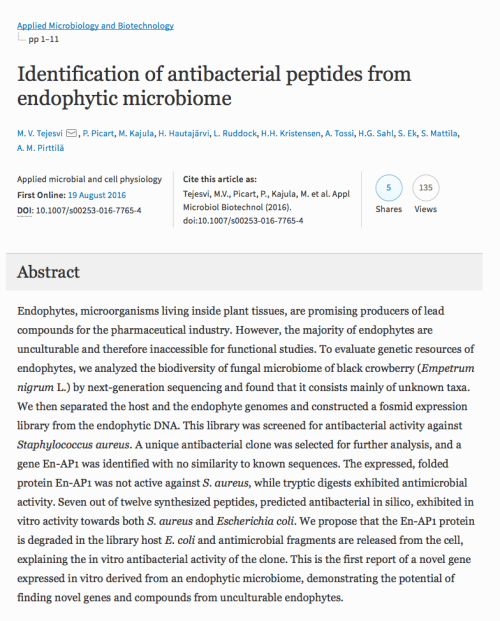
Endophytic microbiome in crowberry? What?

I have to admit. I had to look up what endophytic micro biome was, but it is truly fascinating. They are microbes that live inside plant tissues, in this case, the crowberry, Empetrum nigrum. The authors identified one of these microbes inside the crowberry that has antibacterial activity, specifically a Staphylococcus bacterium. They propose that the presence of this endophyte might have value in the pharmaceutical industry to fight bacterial diseases. So the crowberry itself is not antibacterial. It’s a litter microbe inside the tissues! empetrum

Fertilizing the Tundra

This article verifies what a lot of wild stand managers have known. Adding fertilizer to wild habitats, as long as 30 years, increases grasses and deciduous shrubs and decreases the number of species. In only one habitat type – moist acidic tussock tundra – did the cloudberry, Rubus chamaemorus, increase over the years and only as an understory plant beneath dwarf birch, Betula nana. The article does not address berry yield, but I suspect, it decreased. Reductions in light levels and crowding beneath the shrubs probably made it harder for pollinators to work even if the plants produced flowers. oecologia

Bog blueberries in the Garden

IMG_4813 copy

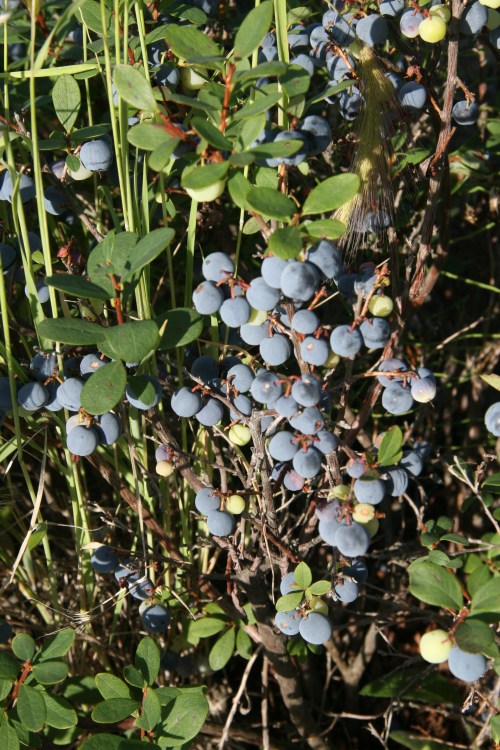
Transplanted bog blueberries, Vaccinium uliginosum,  from the wild can be planted in a garden with soils amended with peat moss. Productivity can be incredible once the plants become established. They also root from buried stems, and these can be cut from the mother plant and transplanted into a garden. Stem cuttings and seeds also work.

A new haskap cultivar from Maxine Thompson

Maxine Thompson has introduced several haskap cultivars over the years, and ‘Taka’ is the latest.

New Plant Patent

Phenology of Cloudberries and Lingonberries in Labrador

Here is a link to an article by Canadian Researchers who are interested in following the growth, flowering and fruiting of two of the most important wild berries, cloudberry and lingonberry. They followed phenological sequences of flowering and fruiting and documented potential pollinators in their region.  It is interesting to compare their cycles with Alaska. It was published in:

Canadian. Journal. of Plant Science. 96: 329–338 (2016)

Cloudberry and Lingon phenology

Abstract: Plant habitat, growth, fruit yield and occurrence of pollinators in cloudberry and lingonberry fields/bogs were monitored and analyzed at three locations in southern Labrador: Lanse’au Clair (51°41’ N, 57°08’ W), Red Bay (51°43’ N, 56°26’ W), and Cartwright (53°42’ N, 57°0’ W) over the two growing seasons, 2011 and 2012. The length of the growing seasons was 100–120 d (DFRA 2014) with 600–700 growing degree days (GDD) (AAFC 2014). The 2012 season was warmer than 2011. The plants recorded in belt transects belong to six families: Rosaceae, Ericaceae, Pottiaceae, Juncaeae, Equisetaceae, and Sphagnaceae. In the Ericaeae family, Vaccinium vitis-idaea, Arctostaphylos alpina, Empetrum nigrum, and Vaccinium angustifolium were found. In both seasons, the cloudberry was the first to bloom, followed by wild blueberry, lingonberry, and Labrador tea. The fruit yields of cloudberry and partridgeberry in southern Labrador were higher than those recorded in Finland, Norway, and in the USA. Pollinators were present in large numbers. Most of the specimens were from three orders: Hymenoptera, Diptera, and Lepidoptera. Temperature, precipitation, wind, and sunlight affected plant growth and the occurrence of pollinators. To our knowledge this is the most comprehensive study of plant growth, yield, and pollinators’ activity in cloudberry/partridgeberry fields conducted in Southern Labrador, Canada.

Native Alaskan Ethnobotany

Check out this link to a series of movies about Alaskan Ethnobotany. One video is specifically on berries.

Alaska Ethnobotany

Haskap oral delivery system

I first read this thesis and laughed hysterically at the thought of developing an “oral delivery system for haskaps”. The author experimented with methods of optimum release and absorption of anthocyanins from haskaps. She developed “a theoretical physiologically-based, multi-compartmental pharmacokinetic (PBPK) model to describe the fate of anthocyanin”. Got that? So my myopic brain thought, “Here’s a novel oral delivery system– just eat the berries!”  Right?  After I stopped laughing, I read a little deeper and learned this article very seriously addresses haskaps as medicine. Think about a Type 1 diabetic who needs shots or a pump to deliver a measured amount of medicine throughout a 24-hour period. This research attempts to find out the best way to deliver measured amounts of anthocyanins from haskaps over long periods. I still prefer shoveling the berries into my mouth, but what would happen if you constantly bathed your cells in anthocyanins over hours, days, years? Interesting thought!

Haskap medicine

Grafting workshop in Fairbanks

Join Steve Mastermind for a grand time grafting apple trees. There is a charge as well as two sessions, one for beginners and one for people who have done it before. RSVP as must.   Grafting Workshop 2016

Aronia Cultivation and Research

This article summarizes current research at Iowa State on Aronia cultivation.  It includes short summaries on field cultivation all the way to health benefits.

Aronia Berries

And these researchers in Wisconsin are honing in on the antioxidant components of Aronia and whether they can be absorbed by animal systems. Lots of berries have many chemicals labeled as antioxidants, but many of them never make it out of the intestines or into the brain, so their value may not be what is claimed.

Aronia berries and antioxidants

Blueberries and health

This summary of ongoing research shows some of the health benefits of blueberries from brain health to slowing down the process of graying hair. Interesting tidbits throughout, although they are mostly talking about “lower 48” species of blueberries. (Ours are probably better! Ha!)

Blueberry research for your health


Soils Webinars

Here is a link to a wealth of information on soils and soil conservation. This site is full of webinars on all kinds of topics sponsored by the Natural Resources Conservation Service.

NRCS webinars

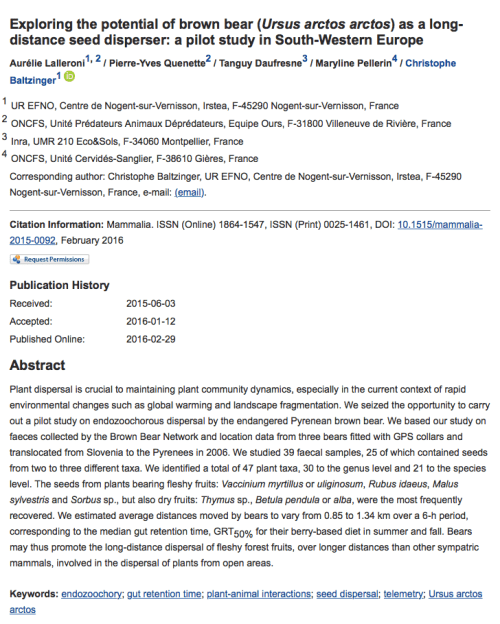
The benefits of bear scat!

Did you know Pyrenees brown bears travel between 0.5 and 0.8 miles after they have gorged themselves on berries before they have to leave a deposit somewhere? That’s how far bears can transport seeds such as wild blueberry and raspberry from their favorite berry harvesting sites. Now think about it from the plant standpoint. That’s not a bad way to get your genes transported all over the landscape rather quickly!

bear dispersal